


I think it’s safe to say that no team sets out to build a workload automation ecosystem that’s fragmented, confusing, expensive, and complex. Yet so many end up there. Why?
The answer isn’t surprising. Workload automation ecosystems—or “batch environments”—evolve over time. They’re rarely designed from scratch. Instead, they grow organically, shaped by urgent business needs, legacy systems, and siloed teams. Because their workflows often underpin the most critical processes across the organization, they attract scrutiny from senior leadership—especially when things go wrong.
How do these environments become so unwieldy? And more importantly, how do we prevent that fate?
The automation paradox: More tools → less clarity
In theory, automation should simplify operations. But in practice, it often introduces new layers of complexity. As organizations adopt more tools—each solving a narrow problem—they create fragmented ecosystems with overlapping schedulers, inconsistent documentation, and brittle dependencies.
This is the automation paradox: the more you automate without a strategic framework, the more chaotic your environment becomes and the more likely you are to repeat the mistakes of the past.
Without a clear roadmap, automation becomes reactive. Teams build scripts to fix yesterday’s problems. Visibility suffers. SLAs slip. And soon, the very tools meant to promote efficiency become barriers to agility.
Here’s a real-life example from a company we’ve worked with in the past: This company, a large financial services firm, periodically managed a prolonged, multi-team project, called a “critical batch optimization” or CBO. They knew their most critical workflows were not meeting their needs, which required a concerted effort to get everything back on track. The process was expensive, unproductive, and worst of all, temporary. Numerous CBOs were required over the years.
The Workload Automation Maturity Curve
To navigate automation effectively, organizations need a structured path. At Telemetry IQ, we use our framework, the Workload Automation Maturity Curve, to help companies establish this foundation. This framework helps guide teams from fragmented execution to intelligent, self-healing orchestration.
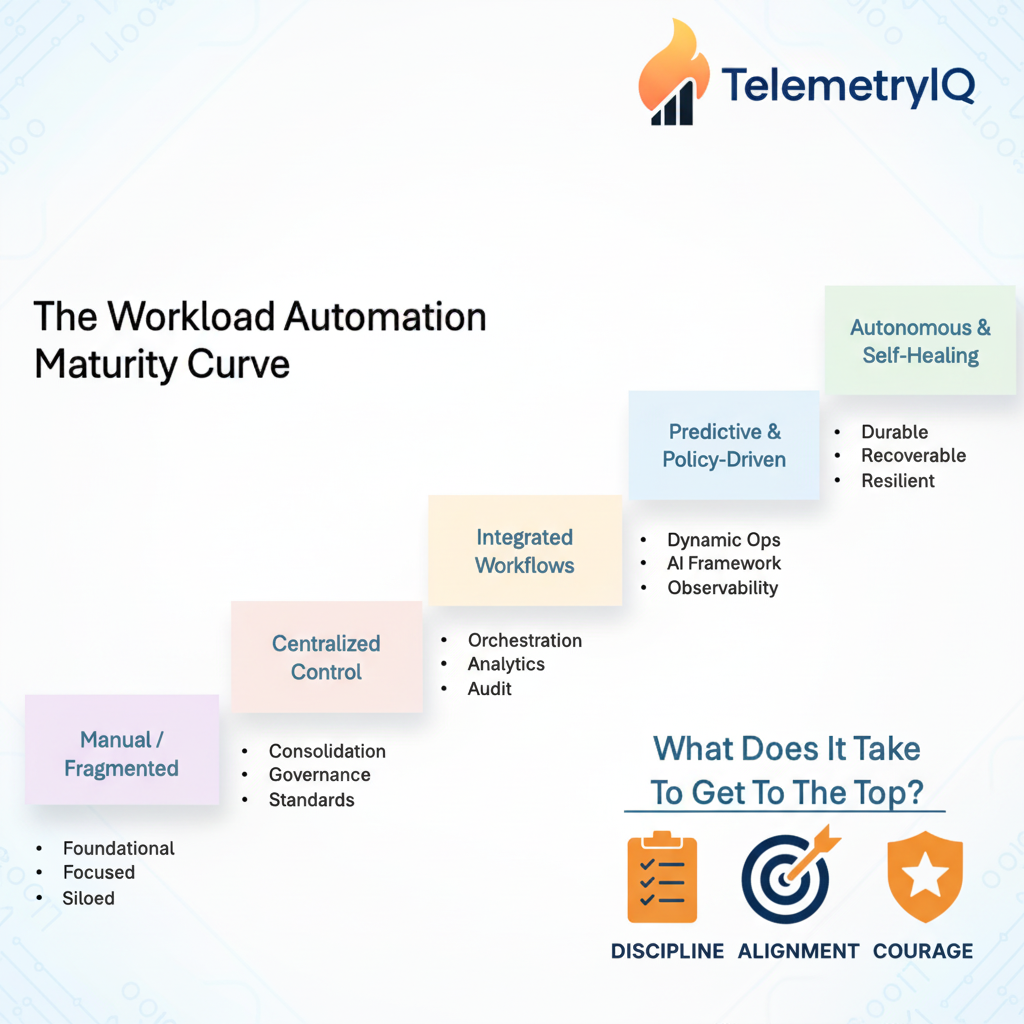
Level 1: Manual and fragmented
The foundation is reactive and error prone. Teams rely on siloed schedulers, script-based automation, and manual interventions. Visibility is low, and documentation is inconsistent. However, it meets short-term needs and the organization typically documents and defines what is important. Staying here for any length of time is a recipe for reactiveness.
Key markers:
- Workload definitions are still in progress
- Basic or extremely siloed schedulers
- Heavy reliance on manual execution or basic scripting
- Little or no logging
- Error-prone dependencies
Level 2: Centralized control
Consolidation begins. A unified scheduler improves visibility and governance. SLA tracking and role-based access controls reduce duplication and errors. If the definitions from level 1 were done properly, then this is an easy leap forward. If the architecture team isn’t involved in level 1, then they are desperately needed in this level. Workflows aligned to business needs early in the game will save time and effort later.
Key markers:
- Platform rationalization of schedulers begins
- SLA are defined and tracked
- Standards, templates, and reusability are key deliverables
- Basic alerting and notifications
Level 3: Integrated workflows
Automation becomes orchestration. Systems communicate across cloud services, on-premises environments, and containers. Real-time monitoring and event-driven triggers enable dynamic, but not necessarily durable, execution.
Key markers:
- Cross-platform integration creates more complex workflows
- Dependency mapping and visualizations align with business requirements
- Real-time monitoring (and hopefully analytical reporting)
- Version control and audit trails to support change management standardization
Level 4: Predictive and policy-driven
Automation adapts to business logic. Predictive analytics forecast issues before they occur. Policies drive dynamic resource allocation and exception handling. Error budgets are established. Business needs take priority, but technical resilience is a must.
Key capabilities:
- Policy-based automation rules enforce standards
- Predictive analytics point you to potential issues
- Dynamic resource allocation allows for some self-healing
- Business service mapping allows operations to understand impact
- Exception Handling frameworks promote expedited root cause analysis (RCA)
Level 5: Autonomous and self-healing
Automation becomes intelligence. Dynamic execution becomes durable execution. Durable execution is the aspirational goal technologists strive towards. Workflows are architected with the ability to examine, adapt, and recover. AI-driven remediation and closed-loop feedback systems enable workflows to optimize and align with business goals—without human intervention.
Key capabilities:
- AI-driven remediation improves RCA and recovery operations
- Self-healing workflows successfully demonstrate execution of simultaneous recovery steps
- Closed-loop feedback systems are business-aligned and drive improvement
- Heuristic models establish a baseline of normal behavior and therefore a predictive capability to avoid impact
Business impact at every stage
Advancing to each level of maturity delivers measurable benefits:
|
Maturity level |
Business impact |
|
Level 1 |
High error rates, manual overhead, limited scalability |
|
Level 2 |
Improved reliability, reduced duplication, better SLA performance |
|
Level 3 |
Scalable orchestration, real-time visibility, cross-platform agility |
|
Level 4 |
Proactive issue avoidance, business-aligned automation, cost optimization |
|
Level 5 |
Autonomous operations, continuous improvement, strategic differentiation |
Common pitfalls to avoid
Even with the right tools, many organizations stumble. Here’s why:
- Poor documentation: Automating unclear processes magnifies inefficiencies.
- Premature complexity: Jumping to advanced features without foundational stability creates complexity.
- Limited or no cross-functional buy-in: Automation must serve business, not just IT.
- High implementation costs: Without clear ROI, investments stall.
- Skill shortages: Advanced orchestration requires specialized expertise.
- Acceleration instead of optimization: Speed without strategy leads to fragility.
- Lack of security governance: Automation must be compliant and auditable.
Final thoughts
Navigating the workload automation maturity curve requires clarity of vision, executive sponsorship, and specialized expertise.
“Great technology elevates technologists…
Great technologists elevate technology”
Start by assessing your current maturity level. Map out a strategic plan that aligns with your business goals. Invest in those people who will lead you up the maturity curve. From there, find a partner with technology and experts who can guide you through each stage and who are up to this challenge.
Let’s turn chaos into clarity—and make automation a strategic advantage. To learn more about what we do at Telemetry IQ visit us at www.telemetry-iq.com or contact me on LinkedIn.
Interested in learning about how Automation by Broadcom solutions can help you modernize your workload automation landscape? Read more here: Workload Automation Modernization.


